Great idea. Now what?

A new idea can be exciting because it holds so much potential. It’s fun to dream, but when the concept moves toward reality, it can create more questions than answers. Where and how you plant that idea will give it the best chance to grow, take root, and become a mature tree.


Maybe the idea developed within an existing company as a solution to a problem the business was facing, like Basecamp for 37 Signals. Perhaps it is a new idea or a startup. No matter how and where it was conceived, some questions need to be answered before the concept makes its way to the launchpad. Is there a need in the market? Who is the audience? How will it get the financing to get developed? How can you protect it with a patent? Most of these questions entrepreneurs know they need to answer. One question they may not have thought of is, “How will it end?” It may sound weird to think of how it will end at the beginning of a new endeavor, but it can provide clarity.


If you already own a company and the idea was conceived internally to solve a problem, your question would be: Should a new endeavor be part of your existing company?


If this is the case, these questions would need to be answered:

1. Could it be used by an entirely different audience, industry, or business type?

2. Does it add value to your brand?

3. Does it help your customer?

4. Does it support the purpose of the company?

5. Could it become a separate division or sub-brand of the parent company?

6. Could it be sold off later to another company?


Think about it; you never plant a tree right up against a house. The tree will hopefully have extensive roots. You wouldn’t want to plant it close to a foundation or another tree. When an idea has that kind of potential, you plant it far enough away for it to grow into a mature tree without being hindered by surrounding obstacles. Ideally, it would be far enough away that you could dig around it to transplant it to another yard if you wanted or needed it. The same is true of ideas that spring up within a company and may become their own mature business someday.


If you are a startup or entrepreneur, these questions need to be answered:

1. Do you have experience in this industry?

2. Is your personality a fire-starter — will you be happy, or are you best suited to manage or run the same company over an extended period?

3. Will it need to be sold to a company that has the resources and distribution chain that could make it thrive?

4. Could this idea be marketed to different audiences and different industries?


As an entrepreneur, you will only be happy being an entrepreneur. The fun is seeing it come to life, getting it started, and developing the idea into a viable business. You might get tired of the day-to-day. You might not be the best person to manage the business. Look at Steve Jobs. Until he had Tim Cook to manage the day-to-day, the company was reasonably chaotic. Same with Tesla. There’s a lot of talk about Tesla needing a CEO other than Elon Musk. He’s excellent at solving problems and turning ideas into reality, but may not be the best guy to manage people or the company long-term.


Admitting that your idea would flourish in the hands of a well-established company after you’ve proved its viability takes wisdom and maturity. The same goes for realizing you might not be the best person to run the business long-term. You first must understand that this will not be your only idea, your only business. You will have more ideas and other companies you may want to start in a few years.


Whether you are an entrepreneur with a startup or a well-established company with a possible breakaway product or service, clarifying your purpose (what is the best option for your role in the process) and the purpose of the new product or service is your next step (and should be the first). Knowing your purpose and its purpose is the only way to decide the right direction to take the idea—how and where to plant it for the best chance to flourish.


Clarifying purpose sounds easy but takes time and quite a bit of focus. Check out my Brand Workbook or my Online Branding Course I developed to help facilitate the process.


The body content of your post goes here. To edit this text, click on it and delete this default text and start typing your own or paste your own from a different source.
Jan Paul Ostendorf
By Jan Paul Ostendorf • November 10, 2026
We will look The Cultural and The Visual aspects of being misunderstood and how it affects a business's ability to reach their ideal future.
By Jan Paul Ostendorf • November 10, 2026
The need to be understood on a personal level in business and branding. A clearly communicated purpose (hopefully through the name and brand) helps you quickly determine whether there’s a good fit. Purpose attracts the right people for the right reasons.
By Jan Paul Ostendorf • November 5, 2026
What happens when you ignore a name challenge in South Africa? Sometimes the government picks your new name for you. And it's a number.  In South Africa, a tuckshop called Sun City Tuckshop didn't respond to Sun International's challenge. The tribunal ruled without them and gave them 60 days to drop "Sun City." If they don't, their name becomes their registration number. In the UK, a company called Simpson Thacher & Barlett Ltd (one letter off the law firm Simpson Thacher & Bartlett) was ordered to change its name. It didn't. So the tribunal renamed it 16434548 LTD. Bam. That's the name now. A cease-and-desist letter or a name challenge isn't junk mail. It's a deadline. And a rename you plan is a lot better than one that's done to you.
By Jan Paul Ostendorf • November 5, 2026
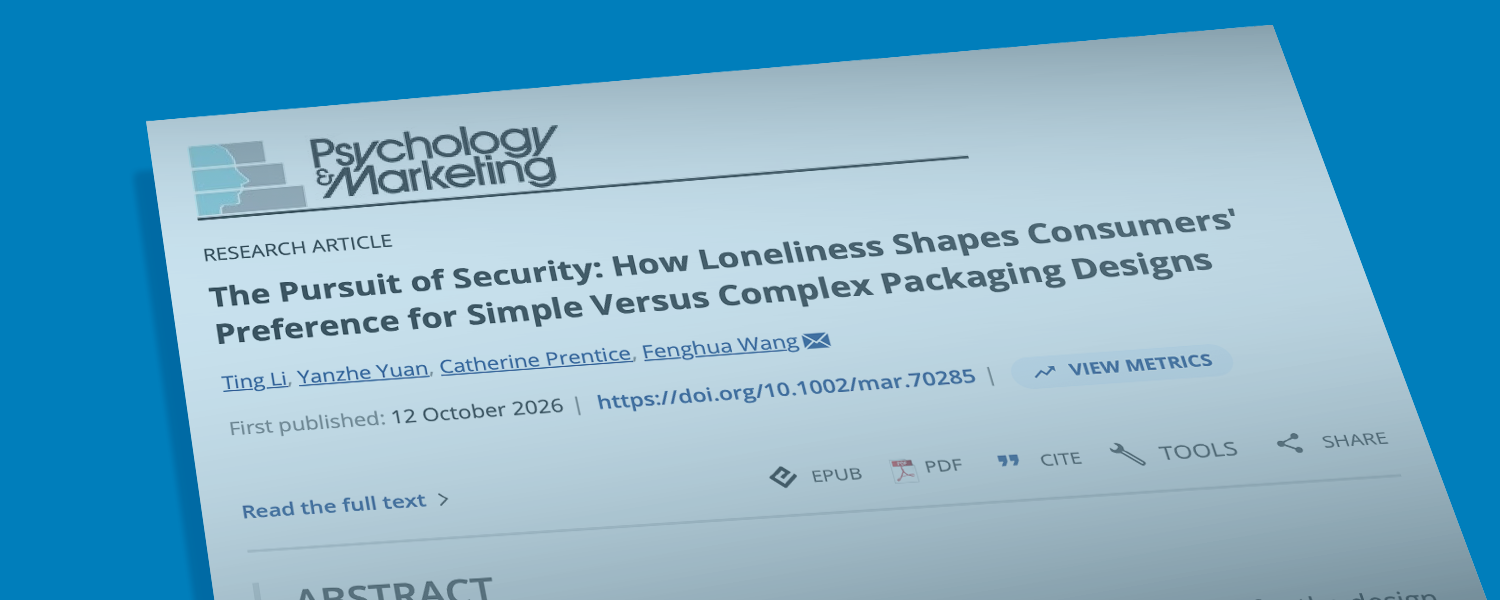
Here's one I didn't see coming. Research on loneliness and packaging gives us a reason to question something we can take for granted in branding: that cleaner and simpler is always better. Better for whom? And what are they looking for when they pick up the product? A paper in Psychology & Marketing, “The Pursuit of Security: How Loneliness Shapes Consumers’ Preference for Simple Versus Complex Packaging Designs” , reports that loneliness increased consumers’ preference for complex packaging. The researchers connect that preference to a desire for “symbolic security.” That doesn't mean we should all start adding more decoration to our boxes. It means the person looking at the package deserves as much attention as the package itself. What the research found The researchers report seven studies involving 1,636 participants: one survey and six experiments. According to the published abstract, loneliness increased preference for complex packaging designs through a desire for symbolic security. In plain language, the proposed explanation is about seeking a sense of security through what the design represents, not about the package making someone physically safer. The relationship wasn't the same for everyone. The link between loneliness and the desire for symbolic security was stronger among people lower in what the researchers call a “security trait,” and weaker among those higher in it. That detail matters. Even within this research, no single response applies equally to everyone. The published abstract gives us a finding about packaging preferences in these studies. It doesn't establish that a particular design will work for your product or your customers. Not a promise of more sales. Not proof that complex packaging is better in every category. And certainly not evidence that buying a product resolves loneliness. Your taste isn't the customer's motivation There's nothing wrong with liking a clean design. But “I like it” and “this works for our customer” are different judgments. You might see a simple package and think it looks confident. Someone else might find it plain or uninviting. You might see a detailed package and think there's too much going on. Another person might appreciate the richness. Those are possibilities to explore, not conclusions to assume. The useful question is why a particular design appeals to a particular person. What are they getting from it beyond the information printed on the front? That's what makes this study interesting to me. It looks beyond the designer's preference and asks about the customer's emotional context. I'm not saying abandon minimalism. I'm saying don't turn it into a rule that saves you from understanding your customer. Start with the benefit, then explore the feeling Before deciding how much to put on a package, I'd ask: Who is your number one customer? What are they trying to do? What benefit does the product genuinely provide? How do you want them to feel when choosing and using it? Then ask how the design might reinforce that feeling. Imagine you're developing packaging for a tea intended for an evening break. You might explore a quiet, simple design and a more detailed, illustrated one. Both could fit the same product, but you shouldn't assume which will feel more welcoming to the people buying it. Show them. Ask what they notice, what they think the product offers, and what feels right or wrong about it. Check whether they can still find the information they need. That's a hypothetical design exercise, not an example from this paper. The point is to make your assumptions testable rather than treating your favorite style as the answer. Understanding isn't permission to exploit There is also a responsibility here. Research about loneliness shouldn't become an excuse to label customers or look for ways to take advantage of them. You can't diagnose a person's emotional life from the packaging they choose. And a sense of comfort suggested by a design isn't the same as delivering care, connection, or security. The useful branding lesson is to pay closer attention to people. Understand what matters to them. Communicate honestly. Make sure the experience supports what the brand suggests. A package can help express a benefit. It can't substitute for one. For me, this connects to the questions behind Unspeakable Attraction: Love, Fear & Your Brain on Branding: why are people attracted to some things and put off by others? What part do emotions play in those responses? This study offers one specific finding worth thinking about. It doesn't answer every branding question. But it gives us a good reason to ask better ones before deciding what our customers should like. If you're interested in this kind of stuff, buy a copy of Unspeakable Attraction on Amazon.
By Jan Paul Ostendorf • November 5, 2026
What a USPTO 2(d) refusal or opposition means for US small businesses, when to fight vs rename, cost reality, and a naming process that screens before you fall in love.
By Jan Paul Ostendorf • November 2, 2026
Every leader hits the same obstacle between today’s brand and the one they want—customers and clients don't understand what we do. Naming expert Jän Paul Ostendorf names it—and how to work past it.
By Jan Paul Ostendorf • October 31, 2026
The 19th Law of Naming: the business is not your product. Why FlexSign taught me this the hard way—and what Ohalo’s DataXray rename gets right and wrong.
By Jan Paul Ostendorf • October 16, 2026
A buyer’s guide from a naming expert since 1989: agency size, cost bands, AI limits, and what you must get at the end—so you don’t waste a six-figure spend.
By Jan Paul Ostendorf • October 14, 2026
Real published ranges from DIY to $150K+ agencies, plus what you get at each level. From Purpose Naming in Atlanta—packages from $1,000 to $45,000.