Your Ideal Future Obstacle, Part 3

We will look at The Cultural and The Visual aspects of being misunderstood and how it affects reaching your ideal future; let’s recap the foundational level of The Personal I went into in Part 2. The Personal deals with finding the right words that adequately communicate our desires to connect. The need to be understood on a personal level entails both understanding yourself and being understood by others. Understanding your purpose helps you make decisions, reduces disappointment, and saves energy. Being understood by others facilitates teamwork, reduces missed expectations, and saves time.

The Cultural

The cultural understanding of common purpose moves from the individual to the group and involves putting all those thoughts into a language that everyone can embrace or not. Clearly defining, expressing then communicating your purpose as a leader and as a company allows leaders to get the right people on the bus for the right reasons.

Peter Drucker, an Austrian-born American management consultant, educator, and author, said, “Only three things happen naturally in organizations: friction, confusion, and underperformance. Everything else requires leadership.” We see breakdowns in leadership when it comes to communication, and it starts when the relationship begins. When a new hire doesn’t live up to expectations, many times, their qualifications and past work experience were prioritized higher than how they align with the core values of the company. Of course, there are other reasons like lack of knowledge, experience, and ability, but those can be developed or predicted and overcome by healthy communication, education and time.

For example, I know a CEO that was having issues with his CFO. He stated that this person was a great employee and conducted all of their responsibilities of the position well but often he had to stop what he was working on to help them when something new (a change to the norm) came across their jib function. He said he liked to teach and help figure out how to handle the new situation better or add to their process. It was the time away from those projects he was working on that seemed to frustrate him the most. When I told him that he needed to define the company’s core values better, he said, “That frou-frou stuff. We are a blue-collar company. We are a large construction product company. We don’t need that corporate mumbo-jumbo.” I told him that he values “self-starters” and “independent thinkers.” He said that was true. I said if you had hired your CFO for being a self-starter rather than the qualification list, he wouldn’t be dealing with that problem. He gets frustrated that his CFO can’t handle something out of the original or develop solutions of their own when a change in the process arises. He agreed.
A UC Berkeley five-year study by management professor Morten Hansen surveyed 5,000 U.S. business professionals. He found that successful leaders are also good communicators who know how to simplify their message, needs, and priorities.

The Visual

The Visual aspect—taking the language and creating visual symbols and signs that support that message affects all those inside and outside the organization. This does include the identity and name, but for simplicity and efficiency for this article, I’m combining them, although a chapter couple is written for both. Since words are written, and in the case of businesses, a logo or name, I include them in the visual aspect. Almost any graphic device to support and communicate the brand visual from UX, icons, illustrations, photos, styles, fonts, etc. would be included. Everything used to visually communicate the brand should align with the company’s purpose, vision, mission, and values.

Understanding at this level is somewhat subjective but should strive to be as objective as possible to communicate a clear understanding of purpose. It’s subjective because people take in vast amounts of information subconsciously and make snap judgments in the background in seconds. People could use this as a reason not to sweat the details of branding; however it can be even more powerful to be intentional about them. To add psychological validity to this argument, when all aspects of communication do not align and support a clear and genuine purpose, trust is suspect. Our minds will first find the discrepancy to be a distraction by calling for our attention, then once noticed — if it doesn’t make sense — becomes confused, unaccepted, and then forgotten. The distraction can be intentional by sometimes a pleasant or funny one to grab our attention, but it must relate to its purpose. One typical example of this is when you hear people say, “Have you seen that commercial (or YouTube video)? It’s hilarious! I can’t remember what it’s for, but it involves a guy that is (they go on to describe the comedic situation but have no idea what company paid 10s of thousands to produce it)….”

As it relates to understanding and arriving at your ideal future, I hear from almost every client I start working with about misconceptions potential customer has during the beginning of the engagement process. And these are with only those they have the opportunity to speak or interact. What about they never having a chance to talk? Salespeople let me know how they need to overcome preconceived ideas about what the company provides or why they exist. Filtering out clients or customers that that have the right need they are well-equipped in delivering a solution. It takes way too much time to communicate who they are. The filtering is a waste of time, energy, and money. The question is: Can this be accomplished through branding on purpose? Yes, it can.

This confusion or miscommunication is hindering the company from attracting the right people for the right reasons, both internally (employees) and externally (clients or customers). It slows down the company’s ability to reach their ideal future state because their brand is not communicating their ideal future state.

Nothing excites me more than to hear that my clients have overcome business problems and streamlined their sales and marketing process because of the branding work we’ve done together. Eliminating those communication barriers and making those outside the company quickly understand what makes their company so great is immensely rewarding.



The body content of your post goes here. To edit this text, click on it and delete this default text and start typing your own or paste your own from a different source.
Jan Paul Ostendorf
By Jan Paul Ostendorf • November 12, 2026
At the beginning of a new idea or brand, think about the end.
By Jan Paul Ostendorf • November 10, 2026
The need to be understood on a personal level in business and branding. A clearly communicated purpose (hopefully through the name and brand) helps you quickly determine whether there’s a good fit. Purpose attracts the right people for the right reasons.
By Jan Paul Ostendorf • November 5, 2026
What happens when you ignore a name challenge in South Africa? Sometimes the government picks your new name for you. And it's a number.  In South Africa, a tuckshop called Sun City Tuckshop didn't respond to Sun International's challenge. The tribunal ruled without them and gave them 60 days to drop "Sun City." If they don't, their name becomes their registration number. In the UK, a company called Simpson Thacher & Barlett Ltd (one letter off the law firm Simpson Thacher & Bartlett) was ordered to change its name. It didn't. So the tribunal renamed it 16434548 LTD. Bam. That's the name now. A cease-and-desist letter or a name challenge isn't junk mail. It's a deadline. And a rename you plan is a lot better than one that's done to you.
By Jan Paul Ostendorf • November 5, 2026
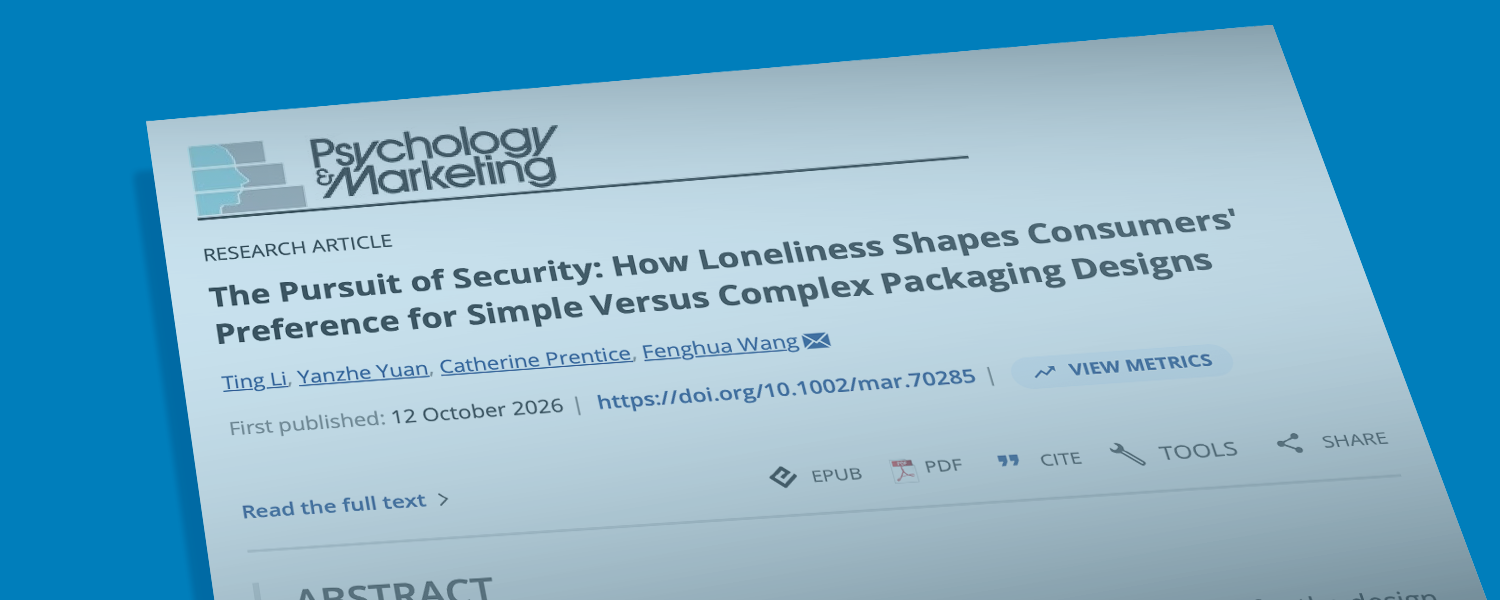
Here's one I didn't see coming. Research on loneliness and packaging gives us a reason to question something we can take for granted in branding: that cleaner and simpler is always better. Better for whom? And what are they looking for when they pick up the product? A paper in Psychology & Marketing, “The Pursuit of Security: How Loneliness Shapes Consumers’ Preference for Simple Versus Complex Packaging Designs” , reports that loneliness increased consumers’ preference for complex packaging. The researchers connect that preference to a desire for “symbolic security.” That doesn't mean we should all start adding more decoration to our boxes. It means the person looking at the package deserves as much attention as the package itself. What the research found The researchers report seven studies involving 1,636 participants: one survey and six experiments. According to the published abstract, loneliness increased preference for complex packaging designs through a desire for symbolic security. In plain language, the proposed explanation is about seeking a sense of security through what the design represents, not about the package making someone physically safer. The relationship wasn't the same for everyone. The link between loneliness and the desire for symbolic security was stronger among people lower in what the researchers call a “security trait,” and weaker among those higher in it. That detail matters. Even within this research, no single response applies equally to everyone. The published abstract gives us a finding about packaging preferences in these studies. It doesn't establish that a particular design will work for your product or your customers. Not a promise of more sales. Not proof that complex packaging is better in every category. And certainly not evidence that buying a product resolves loneliness. Your taste isn't the customer's motivation There's nothing wrong with liking a clean design. But “I like it” and “this works for our customer” are different judgments. You might see a simple package and think it looks confident. Someone else might find it plain or uninviting. You might see a detailed package and think there's too much going on. Another person might appreciate the richness. Those are possibilities to explore, not conclusions to assume. The useful question is why a particular design appeals to a particular person. What are they getting from it beyond the information printed on the front? That's what makes this study interesting to me. It looks beyond the designer's preference and asks about the customer's emotional context. I'm not saying abandon minimalism. I'm saying don't turn it into a rule that saves you from understanding your customer. Start with the benefit, then explore the feeling Before deciding how much to put on a package, I'd ask: Who is your number one customer? What are they trying to do? What benefit does the product genuinely provide? How do you want them to feel when choosing and using it? Then ask how the design might reinforce that feeling. Imagine you're developing packaging for a tea intended for an evening break. You might explore a quiet, simple design and a more detailed, illustrated one. Both could fit the same product, but you shouldn't assume which will feel more welcoming to the people buying it. Show them. Ask what they notice, what they think the product offers, and what feels right or wrong about it. Check whether they can still find the information they need. That's a hypothetical design exercise, not an example from this paper. The point is to make your assumptions testable rather than treating your favorite style as the answer. Understanding isn't permission to exploit There is also a responsibility here. Research about loneliness shouldn't become an excuse to label customers or look for ways to take advantage of them. You can't diagnose a person's emotional life from the packaging they choose. And a sense of comfort suggested by a design isn't the same as delivering care, connection, or security. The useful branding lesson is to pay closer attention to people. Understand what matters to them. Communicate honestly. Make sure the experience supports what the brand suggests. A package can help express a benefit. It can't substitute for one. For me, this connects to the questions behind Unspeakable Attraction: Love, Fear & Your Brain on Branding: why are people attracted to some things and put off by others? What part do emotions play in those responses? This study offers one specific finding worth thinking about. It doesn't answer every branding question. But it gives us a good reason to ask better ones before deciding what our customers should like. If you're interested in this kind of stuff, buy a copy of Unspeakable Attraction on Amazon.
By Jan Paul Ostendorf • November 5, 2026
What a USPTO 2(d) refusal or opposition means for US small businesses, when to fight vs rename, cost reality, and a naming process that screens before you fall in love.
By Jan Paul Ostendorf • November 2, 2026
Every leader hits the same obstacle between today’s brand and the one they want—customers and clients don't understand what we do. Naming expert Jän Paul Ostendorf names it—and how to work past it.
By Jan Paul Ostendorf • October 31, 2026
The 19th Law of Naming: the business is not your product. Why FlexSign taught me this the hard way—and what Ohalo’s DataXray rename gets right and wrong.
By Jan Paul Ostendorf • October 16, 2026
A buyer’s guide from a naming expert since 1989: agency size, cost bands, AI limits, and what you must get at the end—so you don’t waste a six-figure spend.
By Jan Paul Ostendorf • October 14, 2026
Real published ranges from DIY to $150K+ agencies, plus what you get at each level. From Purpose Naming in Atlanta—packages from $1,000 to $45,000.